
The process
The pottery vocabulary you will actually use in class
A practical English–Spanish guide to the words you hear while shaping, joining, drying, and finishing a piece.
Start with the material: clay and clay body
Clay is the material you shape; a clay body is a prepared mixture selected for particular working and firing properties. In a Mexican studio you may hear barro in everyday conversation and arcilla in a more technical explanation. Ask what material you are using and keep that information with your project notes. Its name is more useful than describing it only as white or brown clay.
Earthenware, stoneware, and porcelain refer to broad categories, not interchangeable products. In Spanish you may hear barro de baja temperatura, gres, and porcelana. The specific body matters more than a general label when deciding how it should be fired or used. Let the studio select compatible materials rather than combining unfamiliar clays yourself.
Words for preparing and shaping
Wedging, often described as amasado in Spanish, is a clay-preparation technique. Your instructor can show you the method used in class. Handbuilding is modelado a mano: shaping without throwing on a wheel. Within it, pinching is pellizco, coiling uses rollos or churros, and slab building uses placas. These words describe how you construct a form, not a ranking of difficulty.
Wheel throwing is trabajo en torno or modelado en torno. Centering is centrar el barro. Opening makes the hollow from which a vessel develops, and pulling the walls moves clay upward into its sides. When listening to a demonstration, connect each word with the visible movement. You do not need to memorize the whole sequence before your first attempt.
Words that describe moisture and firmness
Wet or soft clay is still readily shaped. Leather-hard, often called dureza de cuero, describes a firmer stage where the work can hold its form while some refining tasks remain possible. Bone-dry means the unfired piece has reached a dry stage before firing. These terms refer to the material’s condition, not a fixed countdown after class.
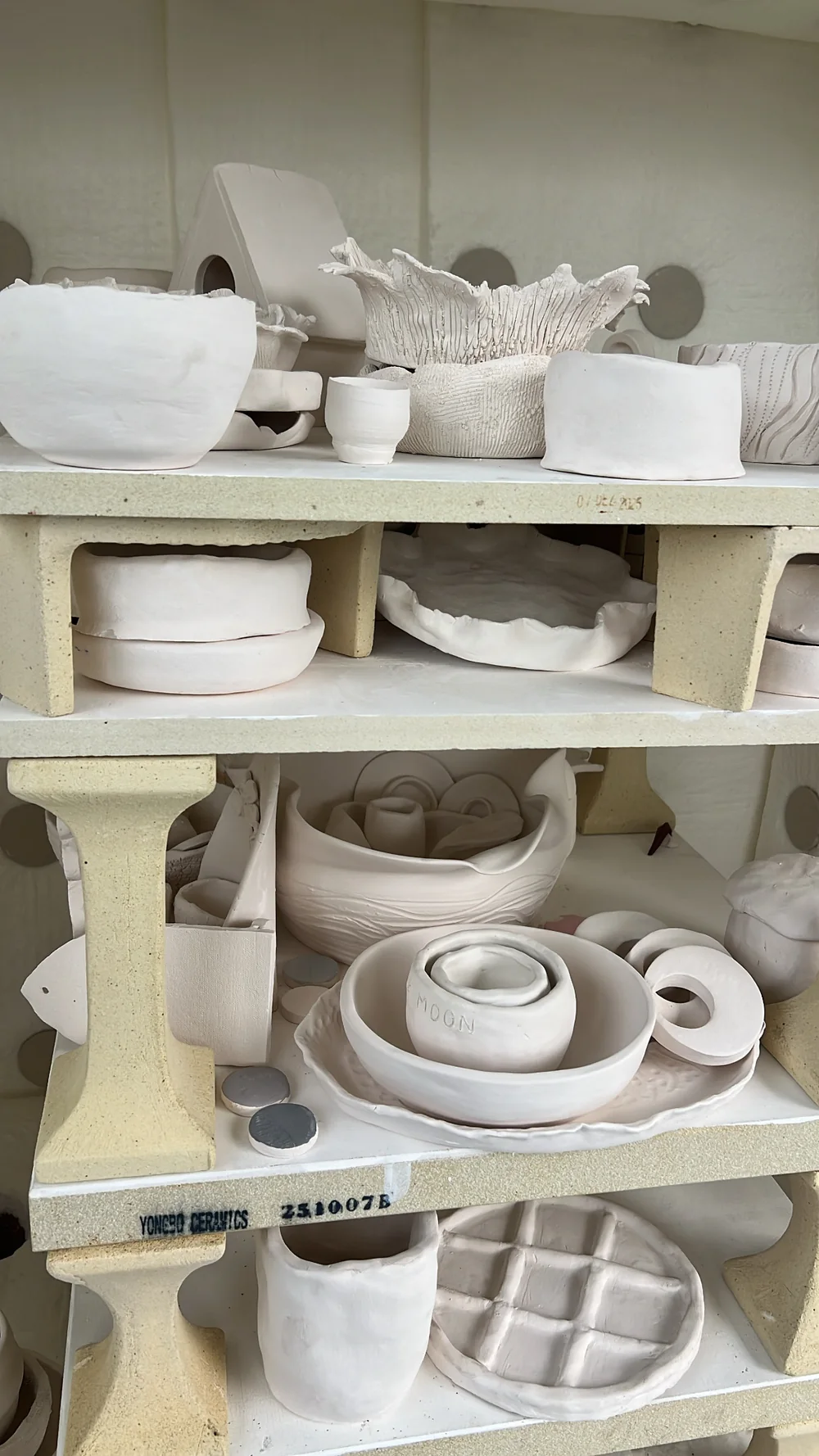
Greenware means unfired work. It can describe pieces at different stages of drying, so ask which condition the speaker means. A leather-hard cup and a fully dried cup need different handling even though neither has been fired. The practical question is always what the piece is ready for now: joining, refining, drying further, or being assessed for a kiln load.
Words for joining and finishing a form
Scoring is making marks on joining surfaces; in Spanish you may hear rayar las superficies de unión. Slip, or barbotina, is a clay-and-water mixture used in several ceramic processes, including some joining methods. Follow the studio’s method and ask how moist the parts should be. Knowing the word for a technique does not replace seeing it demonstrated.
Trimming, often retorneado for wheel work, refines a form after its initial shaping. A foot or base may be adjusted as part of that work. A rib is a shaping or smoothing tool; ask which tool the instructor means rather than relying on a translation alone. Tool names and local vocabulary can vary between studios.
Words for heat and surface
A kiln is a horno cerámico. Firing is cocción or quema. A common first firing is the bisque firing, called bizcochado or primera quema. Glaze is esmalte, a coating that develops its fired surface in the kiln. A glaze firing is the stage in which that surface is fired according to the studio’s materials and process.
You may also hear engobe and bajo esmalte. These describe other approaches to color or surface treatment, but products and instructions differ. Ask what you are applying, at which stage, and whether another coating is needed. A cone number is a ceramic firing reference; leave firing decisions to the studio rather than treating the number as a home-oven setting.
Turn unfamiliar words into useful questions
If a term is unclear, ask the instructor to point to an example. “Can you show me what leather-hard feels like?” gives you a more useful reference than memorizing a definition. “Which areas should stay free of glaze?” connects vocabulary to the next decision in your project.
Keep a small bilingual note with the words you use most often, a photo of the tool or stage, and a sentence about what you did. Your vocabulary will grow alongside your practice. Understanding a few terms in context will help you follow a class far more than collecting a long list you have never used.
Read a project description one stage at a time
Imagine hearing that a handbuilt cup will be refined at the leather-hard stage, bisque fired, glazed and fired again. That short sentence describes several different decisions and moments. You do not need to memorize every definition before asking a practical question. Begin by locating your piece in the sequence: what has already happened, what is happening now and what needs to happen before the next visit?
Then connect each term to an action you can see. Ask the instructor to show what they mean by refining a rim or preparing a join. Compare the demonstration with your own piece while it is still at the appropriate stage. A word becomes easier to remember when it is attached to a physical observation rather than a definition copied into a notebook without context.
Keep your own small bilingual vocabulary if you switch between English and Spanish. Write down the term used by the instructor, what you observed and the question it helped you answer. Studio vocabulary can vary, so ask whether two unfamiliar words refer to the same process instead of assuming that a different name means a completely different technique.
When reading a product or class description, separate material, method, finish and service. The clay body describes a material; handbuilding describes a method; a surface description concerns the finish; collection arrangements concern the service. Knowing which kind of information is missing helps you ask a precise question. No single ceramic term establishes everything about an object’s use, care or readiness to take home.